Most calls we get from property managers start the same way. Somebody drives up to their own building for the first time in a while, actually looks at it, and realizes the place looks tired. Green streaks on the north-facing siding. Black stair treads. Oil rings in the parking lot. Gutters with dark tiger stripes running down them. None of it happened overnight, and that is the whole problem. It creeps up on you until a prospective tenant pulls in, takes one look, and keeps driving.
This is the story of one of those properties here in Lexington, and what changed after we cleaned it. I am writing it up as a straight case study because the lessons apply to almost any multi-family property in Central Kentucky, from six units to six hundred. I am leaving the property name and address out of it out of respect for the owner. Everything else is real: the surfaces, the problems, the process, and the results.
The Property Behind This Apartment Power Washing Company Lexington KY Case Study
The complex sits on the east side of Lexington, built in the late 1990s. Ninety-six units across eight three-story buildings. Vinyl siding, brick lower facades, concrete stairwells and landings, asphalt parking, and a mix of covered and open walkways. Standard for Central Kentucky rental housing from that era.
The property switched management companies, and the new regional manager inherited a place that had not seen a serious exterior cleaning in at least four or five years, maybe longer. Occupancy was sitting around 88 percent. That does not sound terrible until you do the math and realize it meant roughly eleven or twelve empty units bleeding rent every month. When you are trying to show a vacant unit and the walkway to reach it is covered in cobwebs, with green streaks on the siding above the door, you are fighting an uphill battle before the prospect even walks inside.
The manager called around and got a few quotes. What makes this an interesting apartment power washing company Lexington KY case study is that she did not just chase the lowest number. She wanted someone who understood you cannot treat a lived-in, occupied complex like an empty warehouse. You are working around residents, cars, pets, kids, and people trying to sleep after a night shift. That changes how you plan the whole job.
What we found on the walkthrough
Before I quote a property this size, I walk the whole thing with the manager. Here is what we documented on that first walk:
- Siding: Heavy green and black growth on every north- and east-facing wall. The green is algae. The black is usually mildew and mold feeding on the organic film. In our humid Kentucky summers, siding that never gets direct sun stays damp and grows this stuff fast.
- Stairwells and landings: The concrete stair treads were nearly black down the center, where thousands of footsteps had ground dirt into the surface. Several landings had visible algae, which is a real slip hazard when it gets wet.
- Entry doors and door surrounds: Cobwebs, mud dauber nests, and a gray film on the trim.
- Gutters: Classic tiger striping. Those dark vertical streaks come from oxidation and airborne grime running off the roof edge. Brightening the gutters is one of the fastest ways to make a building look ten years newer.
- Concrete walkways and dumpster pads: Chewing gum, spilled soda, and the sour organic buildup you would expect around the dumpster pads.
- Parking lot: Oil and transmission fluid stains in dozens of spots, plus tire marks near the speed bumps.
None of this was unusual. Every item on that list is one of the common problems that make apartment complexes call a professional in the first place: dirt and grime buildup, mold and mildew, high-traffic wear on walkways and stairs, staining from pollution and weather, and hard water marks near the sprinkler heads. What made it a good story is how much the cleaning changed things, and how measurable that change turned out to be.
Why exterior grime is more than a looks problem
People think of pressure washing as cosmetic. Make it pretty for the leasing photos and move on. That is part of it. But the bigger issue was that the buildup on this complex was actively shortening the life of expensive building materials.
Algae and mildew hold moisture against vinyl siding and painted wood trim. Left alone, that constant dampness breaks down the surface, causes paint to peel, and can lead to wood rot on fascia and trim boards. On concrete, biological growth and standing organic material speed up surface pitting and staining. The oil in the parking lot? Petroleum products soften and degrade asphalt over time. So every one of those problems was a small maintenance bill quietly getting bigger.
Then there is the health angle, which matters more in multi-family housing than almost anywhere else. Mold, mildew, algae, and heavy pollen buildup are allergens. When residents walk past moldy siding and through mildewed stairwells every single day, especially folks with asthma or allergies, you are creating an environment that makes people miserable and gives them a legitimate reason to complain. Cleaning that off is an aesthetic win, sure, but it also makes for a healthier place to live.
The way I put it to the manager: you can spend a little now cleaning this off, or spend a lot later replacing siding, repainting trim, and repaving. Regular cleaning is the cheapest insurance you can buy on a building’s exterior.
The safety piece property managers overlook
The single biggest liability I saw on that property was the stairwells. Concrete stairs with algae on them get slick as ice when it rains. On a three-story building with dozens of residents using those stairs every day, that is a slip-and-fall lawsuit waiting to happen. Removing that biological film is risk management. Same goes for the walkways and the entry landings. Clean, high-traction concrete keeps people upright, and a documented cleaning schedule helps show you took reasonable care of the property if anything ever does go wrong.
Planning the job: logistics of an occupied complex
Here is where an apartment power washing company Lexington KY case study gets useful for property managers, because the planning is where most jobs succeed or fail. Cleaning an occupied 96-unit complex is a completely different animal than washing a single-family house.
We built the schedule around the residents, not around our convenience. The plan looked like this:
- Building-by-building sequencing. We tackled one building at a time so we never shut down the whole property. Residents in the other seven buildings were unaffected on any given day.
- Written notices 72 hours out. The management team posted door hangers and sent emails telling residents which days their building would be cleaned, and asking them to move vehicles, close windows, and bring in patio items and pet bowls. This one step prevents 90 percent of the complaints.
- Early-to-midday work windows. We started at 8 a.m. and wrapped the loud work by mid-afternoon, out of respect for night-shift workers and small kids napping.
- Parking coordination. The manager set aside a temporary overflow area so residents had somewhere to move their cars while we washed the lots and the surrounding sidewalks.
For the multi-story siding, our crew uses soft washing instead of high-pressure blasting. That distinction matters a lot, and it is worth explaining.
Soft washing versus high pressure
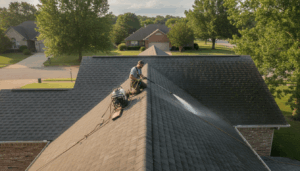
You do not clean vinyl siding, painted surfaces, or roofs by hitting them with 3,000 PSI. That drives water behind the siding, gouges wood, strips paint, and can crack shingles. We use a soft wash system: low pressure combined with professional cleaning solutions that kill the algae, mold, and mildew at the root. The chemistry does the work, not brute force. We apply the solution, let it dwell, and rinse. It comes off cleaner and stays clean longer because we killed the organism instead of just blasting the surface layer.
For hard surfaces like concrete walkways, stair treads, and dumpster pads, that is where controlled higher pressure and surface cleaners come in. A surface cleaner is a spinning attachment that gives you an even, stripe-free clean on flatwork, which is exactly what you want on a big walkway you are trying to make look uniform. Different surfaces, different tools. Knowing which is which is a big part of what you are paying a professional for.
The work: what we actually did, building by building
The full job ran across roughly two weeks of working days, weather permitting. Central Kentucky weather does not always cooperate, so we build a couple of rain days into any project this size. Here is the scope we completed.
House washing the siding
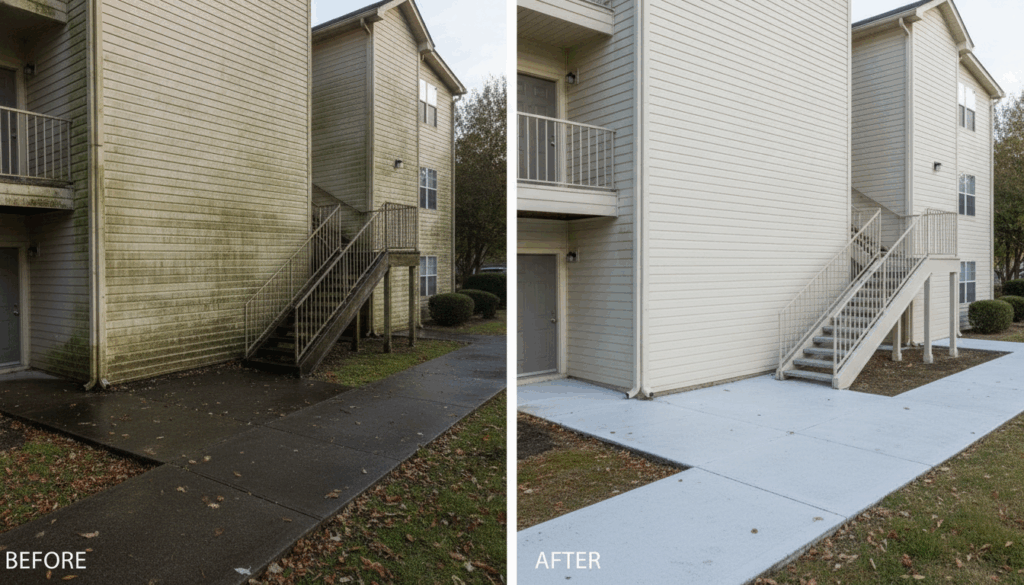
All eight buildings got a full soft wash on every elevation. The north and east walls that had the worst growth were the most dramatic. We would treat a wall, and within a couple of minutes you could watch the green lighten and disappear as the solution did its job. The vinyl came back to its original off-white color, which the manager honestly had not seen since before she took over the property. We also washed the covered walkway ceilings and support columns. Those had cobwebs and grime everybody had stopped noticing, and they made an instant difference once they were clean.
Stairwells, landings, and walkways
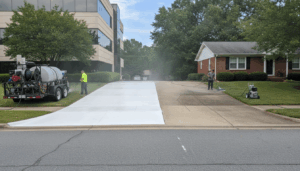
This was the most satisfying part, and the part residents commented on the most. Those near-black concrete treads came back to a clean gray. We treated the biological growth first to eliminate the slip hazard, then surface-cleaned every step and landing. Where gum was ground into the concrete near the entrances, we spot-treated and removed it. The main sidewalks connecting buildings to the parking areas got the same surface-cleaner treatment for an even finish.
Gutter brightening
Gutter brightening is a separate service from a rinse, and it is one of the highest-impact things you can do on an older building. Those dark tiger stripes are oxidation and bonded grime that a normal wash will not touch. We hand-applied a brightening treatment and scrubbed where needed. The gutters went from streaked and gray to clean and bright white. On a building with a lot of visible gutter runs, this alone knocks years off the apparent age of the structure.
Brick facades
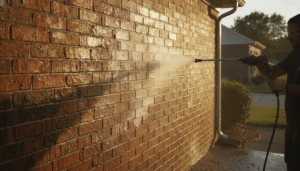
The lower brick sections were soft washed to remove the organic film and dirt buildup without damaging the mortar joints. Brick is more forgiving than vinyl, but you still do not want to attack aged mortar with high pressure, so a soft wash approach was the right call here too.
Parking areas and dumpster pads
We degreased and treated the worst of the oil staining in the lot. Full disclosure for any property manager reading this: deep, old petroleum stains do not always come 100 percent clean. Oil that has soaked into asphalt for years is a different beast than a fresh spill on concrete. We got dramatic improvement on the parking surfaces, and the dumpster pads came out clean and, more importantly, no longer smelled. Setting honest expectations up front on old oil stains keeps everybody happy at the end.
The results: what changed after the apartment power washing company Lexington KY case study
This is the part property managers actually care about, so let me give you the numbers and the outcomes rather than just saying it looked nice.
Curb appeal and leasing
Within a week of finishing, the management team reshot all their leasing photos and updated their listings. The before-and-after difference was so obvious that the regional manager used the photos internally as an example for her other properties. Prospective tenants who tour a clean, cared-for complex form a completely different first impression, and first impressions drive leasing decisions. Well-maintained complexes can support meaningfully higher rents, with some industry figures pointing to premiums of up to around 15 percent for properties that clearly show pride of ownership. The leasing team felt a lot more confident asking full market rate for the refreshed units.
Occupancy and retention
Over the following few months, occupancy climbed from that 88 percent back over 95 percent. I am not going to pretend a pressure washing job single-handedly filled the building. The leasing team’s work matters, and the market matters. But the manager was direct with me that the cleaned-up exterior removed a major objection she kept hearing on tours, and that renewals came in stronger that cycle because existing residents felt like ownership was finally investing in the place. That last part is real. When people see their home being taken care of, they take more pride in it and they are more likely to stay. Reducing turnover is huge, because every unit that turns over costs you cleaning, make-ready, marketing, and vacancy loss.
Resident response
The manager forwarded me a handful of resident comments. A few people specifically mentioned the stairwells feeling safer and cleaner. One person said their kid used to get grime on their hands from the walkway railings and that stopped. Small stuff, but that small stuff is exactly what tenant satisfaction is made of.
Maintenance and longevity
By clearing off the algae and mildew, we stopped the slow degradation of the siding and trim, which pushed back the day the owner has to think about repainting or replacing anything. We also flagged two spots of soft, rotting fascia we found once the grime was washed off, and the maintenance team addressed them early before it spread. That is a hidden benefit of a good cleaning: it uncovers problems while they are still cheap to fix.
The numbers: why this apartment power washing company Lexington KY case study made financial sense
Property managers run on budgets, so let me put the money in plain terms. A full exterior cleaning on a complex this size is a real line item, no question. But compare it to the alternatives.
- Repainting or replacing siding because algae and moisture damage got out of hand runs into the tens of thousands of dollars. Cleaning is a fraction of that cost, and it prevents the damage in the first place.
- A single slip-and-fall claim on an algae-covered stairwell can dwarf the cost of the entire cleaning contract, plus the insurance and legal headache.
- Vacancy loss from four extra empty units at market rent adds up fast over a few months. Filling those units faster because the property shows well pays for the cleaning several times over.
- Turnover costs from residents who leave because the place feels neglected are largely invisible until you total them up.
Framed that way, regular pressure washing is not an expense. It is preventative maintenance that saves money. Same logic as changing the oil in a truck instead of waiting for the engine to seize. That is the core takeaway from this apartment power washing company Lexington KY case study: the return shows up in reduced repairs, better leasing, fewer claims, and higher retention, not just in a nicer-looking building.
How often should a Central Kentucky complex get cleaned?
The right frequency depends on the surface and the exposure. Here is how I generally advise property managers in the Lexington area, given our humid summers and pollen-heavy springs.
Full building soft wash
For the siding and building exteriors, once a year is the baseline in Central Kentucky, and every six months on the buildings or elevations that stay shaded and grow algae fastest. Our climate is friendly to mildew, so north-facing walls surrounded by trees will green up faster than a sunny south wall.
High-traffic concrete
Stairwells, entry landings, and heavily used walkways benefit from cleaning every quarter, or at minimum twice a year. These are the surfaces where safety and appearance matter most and where buildup happens fastest. A quarterly cadence keeps them consistently safe and presentable.
Gutters, dumpster pads, and parking
Gutter brightening as needed, usually annually, keeps buildings looking sharp. Dumpster pads and heavy-use parking areas often warrant a couple of cleanings a year depending on the property. After we established the baseline on this complex, the manager set up a recurring schedule, which is smart. Recurring maintenance is cheaper per visit than a big neglected catch-up job, and it means the property never slides back to where it started.
What to look for in an apartment power washing company in Lexington
If you manage multi-family property in Lexington or anywhere in Central Kentucky and you are pricing out this work, here is what separates a pro from a guy with a rental machine and a truck.
- Insurance and liability coverage. Working on multi-story buildings around residents and vehicles carries real risk. Make sure your contractor carries proper liability insurance and can provide a certificate.
- Soft wash capability. Anybody who wants to blast your vinyl siding with high pressure should be shown the door. Ask specifically how they clean siding and roofs. The answer should be soft washing.
- A real plan for occupied buildings. They should bring up resident notices, scheduling, parking, and working building-by-building without being prompted. If they treat your complex like an empty parking lot, they have not done this before.
- Honest expectations. A good contractor tells you up front what will come 100 percent clean and what, like old oil stains, will only improve. Overpromising is a red flag.
- References on similar properties. Ask for other multi-family or commercial jobs they have done in the area. A relevant apartment power washing company Lexington KY case study or two tells you they have handled the logistics of a job like yours.
- Recurring maintenance options. The best value comes from a scheduled program, not a one-time panic clean. A pro will offer to set that up for you.
The bottom line from this apartment power washing company Lexington KY case study
Here is the honest summary. This complex did not have any rare or exotic problems. It had the exact same buildup that almost every older multi-family property in Central Kentucky develops: algae and mildew on shaded siding, black grime on high-traffic concrete, streaked gutters, and stained parking areas. What it did not have, until the new manager stepped in, was a plan to deal with it.
The cleaning brought the property back from looking neglected to looking cared for. The measurable results were a jump in occupancy, stronger renewals, better leasing photos, a documented reduction in slip hazards, and building materials that got their lifespan extended instead of quietly rotting. The manager spent a fraction of what deferred repairs and lost rent would have cost, and she came out ahead.
That is the whole point of writing up this apartment power washing company Lexington KY case study. If you drive up to a property you manage and it looks tired, it probably is, and it is almost certainly costing you more than you realize in lost leases, higher turnover, and creeping maintenance liability. The fix is straightforward, it is affordable compared to the alternatives, and it pays for itself. Get a walkthrough, get an honest scope, and get on a maintenance schedule. Your residents, your leasing numbers, and your buildings will all be better for it.
If you manage apartments, condos, or any commercial property in Lexington or the surrounding Central Kentucky area and you want a straight assessment of what your exterior needs, that is the kind of work we do every week. No hype, no upselling you into things you do not need. Just a clean building and a plan to keep it that way.
Frequently asked questions
How much does it cost to pressure wash an apartment complex in Lexington KY?
Cost depends on the number of buildings, stories, surface types, and how much biological growth has built up, so we price after a walkthrough rather than by a flat rate. For a mid-size complex it is a real budget line, but it typically costs a fraction of what siding replacement, repainting, or a slip-and-fall claim would run. Most property managers find recurring maintenance is cheaper per visit than a one-time neglected catch-up job.
Will pressure washing damage the vinyl siding on my apartment buildings?
Not if it is done correctly. Professionals use a soft wash system that combines low pressure with cleaning solutions to kill algae and mildew, rather than high-pressure blasting that can force water behind siding or strip paint. Avoid any company that wants to hit your vinyl or roof with high pressure.
How do you clean an apartment complex without disturbing the residents?
We work building by building so the whole property is never shut down at once, and management posts notices about 72 hours ahead so residents can move cars and close windows. We run loud work from morning to mid-afternoon out of respect for night-shift workers and kids. Coordinating parking and communicating clearly prevents almost all resident complaints.
How often should an apartment complex in Central Kentucky be power washed?
A full building soft wash once a year is the baseline in our humid climate, with shaded, algae-prone walls sometimes needing it every six months. High-traffic concrete like stairwells and entries benefits from quarterly cleaning for safety and appearance. Gutters, dumpster pads, and parking areas are usually done once or twice a year as needed.
Does pressure washing an apartment complex actually help with leasing and tenant retention?
Yes. A clean, well-maintained exterior removes a major objection prospective tenants form on tours and helps a property command full market rent. Existing residents also feel ownership is investing in their home, which supports stronger lease renewals and lowers costly turnover.
Can you remove oil stains from an apartment parking lot?
We can significantly improve most oil and fluid stains with degreasing and hot water treatment, and fresh spills on concrete clean up well. Oil that has soaked into asphalt for years may not come 100 percent clean, so we set honest expectations up front. The goal is dramatic improvement and a lot that no longer looks or smells neglected.
Sources
- The Benefits of Power Washing Your Apartment Complex – Ally Waste
- Apartment Complex Building Pressure Washing: Essential Cleaning Benefits – iShine Cincy
- The Benefits of Pressure Washing for Apartment Complexes
- Reasons to Pressure Wash Apartment Complexes – Pristine Clean
- A Complete Guide to Apartment Complex Pressure Washing – HomeSmiles – Preventative Home Maintenance Services
- Pressure Washing’s Impact on Urban Property Value